"When asked, "How do you write?" I invariably answer, "One word at a time," and the answer is invariably dismissed. It sounds too simple to be true, but consider the Great Wall of China, if you will: one stone at a time, man. But I've read you can see that mother****** from space without a telescope."
— Stephen King
That is what thoroughbred conditioning is to me: building an equine Great Wall one stone at a time. A stone is a breeze or race that results in the horse coming back days later stronger, fitter, and sounder. Doesn’t seem like much, a breeze every 6 days, 12 races a season (ideally) – but boy, oh boy can the results add up to something significant as most former Triple Crown champs followed a similar course back in the old days.
One key, of course, is not to drop any of these stones on your foot, because then it’s either off to the farm – or off to the pharmacy and a career filled with multiple injections and stall time designed to simply survive to the next race. See Revenge, I Want.
So, one has to be careful or aggressive, and often the decision is an economic one. It’s much easier to drill on a big sound colt in your backyard who you bought for $20k than it is to drill on a $200k purchase for a deep pocketed owner with the whole world watching.
Where am I going with this? To two descendants of Indian Charlie on the 2011 Derby trail: Comma To the Top and Uncle Mo. Two trainers, Peter Miller and Todd Pletcher. Two owners, a relatively unknown Hollywood partnership and Mike Repole (who I really like, by the way) – he’s no IEAH or David Lanzman.
Interestingly enough, Comma To the Top is gelded – so no stallion career here, we may see this gem race 50 times by age 5. I suspect no one endeavoring to develop a stallion prospect would race 10 times at 2, and breeze 6F in January of a 3yo campaign, this isn’t 1930.
Pedigree, Shmedigree.
Here we have the genetics of Indian Charlie in two colts – so ideally we have a fairly similar starting point. Regular readers know I put little emphasis on breeding: genetics simply set the blueprint for what is possible – but conditioning/racing dictates how much of that blueprint is developed, or squandered.
Let’s take just one simple measurable (at autopsy) physiological trait: the number and function of mitochondria in muscles. Mitochondria are the energy powerhouses that take oxygen from the blood and transfer it into muscular energy which propels a horse down the track.
Genetics may dictate a colt is born with 20 of these things in a particular muscle, but appropriate physical conditioning increases this number, if done correctly. The more you ask the equine body to produce mitochondria – they more it gives you. The more it gives you, the greater your ‘cruising speed’ as Todd Pletcher astutely calls it. I define this as V200 – how fast you can travel when your oxygen carrying system is maxed out and you must tap into that 3-4F of anaerobic burst most thoroughbreds possess.
And you aren’t asking for much development when breezing a short 4F every 10 days and only racing 2-3 times in your 2 year old year. You are playing it safe to avoid injury and maximize residual value should you capture your black type.
When it comes time to physical conditioning the paths of Comma To the Top and Uncle Mo diverge very quickly. Who has developed more mitochondria since birth and therefore possesses more stamina at this moment in time? Let’s enumerate the training/racing schedules of each:
Uncle Mo – No DRF recorded workouts for this one. But Pletcher says he should get his first 3F move since last November’s Breeders Cup victory at Palm Meadows this upcoming week.
| Horse Name | Date | Track | Dist | Time | Surf | Cond. | B/H | |
| Comma to the Top | 01/25/2011 | HOL | 6F | 1:10.40 | All Weather Track | Fast | H | |
| 01/19/2011 | HOL | 6F | 1:14.80 | All Weather Track | Fast | H | | |
| 01/13/2011 | HOL | 5F | :59.80 | All Weather Track | Fast | B | | |
| 01/07/2011 | HOL | 4F | :48.40 | All Weather Track | Fast | B | | |
| 12/12/2010 | HOL | 5F | :59.40 | All Weather Track | Fast | H | | |
| 12/06/2010 | HOL | 4F | :48.20 | All Weather Track | Fast | H | | |
| 11/21/2010 | HOL | 5F | :59.40 | All Weather Track | Fast | H | | |
| 11/15/2010 | HOL | 4F | :48.40 | All Weather Track | Fast | H | | |
| 11/01/2010 | HOL | 4F | :47.40 | All Weather Track | Fast | H | |
Career race results:
Uncle Mo - Race Results & Past Performances
[Add Race Result][Add Horse]
|

Comma To The Top - Race Results & Past Performances
|
Race info courtesy of Horse Racing Nation.
Comma To the Top also had 3 earlier races not reflected here, they were claiming class also – one of us could now own a Derby prospect with $500k+ in earnings for the princely sum of $30k or so, what a great sport this is!-
Where do I get this equine Great Wall metaphor from? Here is a graph from an equine science journal out of Cambridge, Mass:
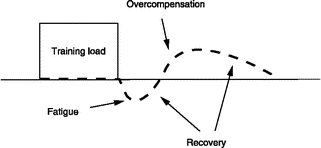
Training load is a breeze/race and the x-axis is elapsed time in days. You see, after a piece of work and the resulting fatigue, there is a period of Overcompensation where the systems of the body make positive adaptations in order to make successive training loads easier to achieve. More mitochondria being one such change. But, if you wait too long before adding another Training Load, you lose the overcompensation effect – and the benefits of cumulative fitness, as seen below in graphical form:

Uncle Mo is line A – few and widely spaced works/breezes resulting in less than optimal fitness development over time.
Comma To the Top is line B – more races, more works, more closely spaced together in an effort to capitalize on the concept of Overcompensation.
Line C is what happens if you breeze/race too much, too often and breakdown occurs – not too common these days – referred to as ‘overtraining’ by most in the industry.
Both have 2 year old experience on dirt, which Nunamaker at New Bolton has proven is best for building strong bones, ligaments, and tendons. I suspect that Comma has many more breezes over this surface during his formative years, however, that does Uncle Mo.
Now Uncle Mo seems destined to a dirt prep season (which I recommend) – and so far Comma is back to synthetics at Hollywood. I hope the connections see fit to try him on dirt again before the Derby (Santa Anita perhaps), or at least train on the dirt loop at Hollywood in order to maximize neuromuscular coordination on that surface going into Churchill.
My two cents: a 50% chance that Uncle Mo will get injured during his prep for the Derby. If he does survive unscathed, Pletcher will lose a few others in his place. He’ll only breeze 4-6F a few times, he’ll only race twice – and I think he comes up lame in the process. I hope not, but that is what I forsee.
I can’t blame Pletcher, with his 2yo exploits, Mo seems like a fantastic specimen that I would be afraid to drill on too much also. Baffert, Lukas, Assmussen, and Pletcher himself win big races with such a prep schedule every year anyway, so they have no reason to change after listening to a nobody like myself.
However, I will be pulling hard for Comma To the Top as his campaign to this point clearly illustrates the one advantage the little guy has over the big operations: conditioning – you can spend more time and effort on each one when you don’t have 200 prospects spread out over 4 strings nationwide. It doesn’t cost one additional dime to train in this manner, simply takes the will and the effort to stand out from the crowd.
With his foundation of race specific works and races, he has the mettle to enter and be competitive at all three classics, while no other lightly trained horse could even run in all three last year. Look for him to be breezing miles in April while most others are still working 4F.
Say Comma To the Top pulls of a Mine that Bird type spring and fall – will trainers then emulate his aggressive prep program, or stay with the Pletcher model?
Traditional horsemanship has pegged Uncle Mo as worth 10x that of Comma To the Top as evidenced by the auction results. Will that stand up throughout the 2011 racing season?
So many questions, and so many answers to follow. I love horseracing.


 Posts